
From Oil Routes to Rice Fields: The Hidden Cost of War for Bangladesh
Wars fought thousands of miles away often feel distant from Bangladesh. But in today’s interconnected economy, conflict in one region can quickly disrupt daily life in another. Rising tensions around the Strait of Hormuz, a narrow corridor through which about 30–40% of Bangladesh’s fuel and LNG imports pass, remind us how closely our food security is tied to global shipping routes [1]. When that route becomes risky, the impact can reach Bangladesh’s rice fields faster than diplomacy can react.
For Bangladesh, the transmission channel is straightforward: when the Gulf becomes unstable, energy prices, freight charges and insurance costs rise. Fuel becomes costlier and transport expenses rise across the food supply chain. In an import-dependent economy like Bangladesh, the cumulative result is inflation at the market stall [2].
The government must recognize that this is not merely an energy issue. It is a food security issue. And the most vulnerable point in that system is irrigation.
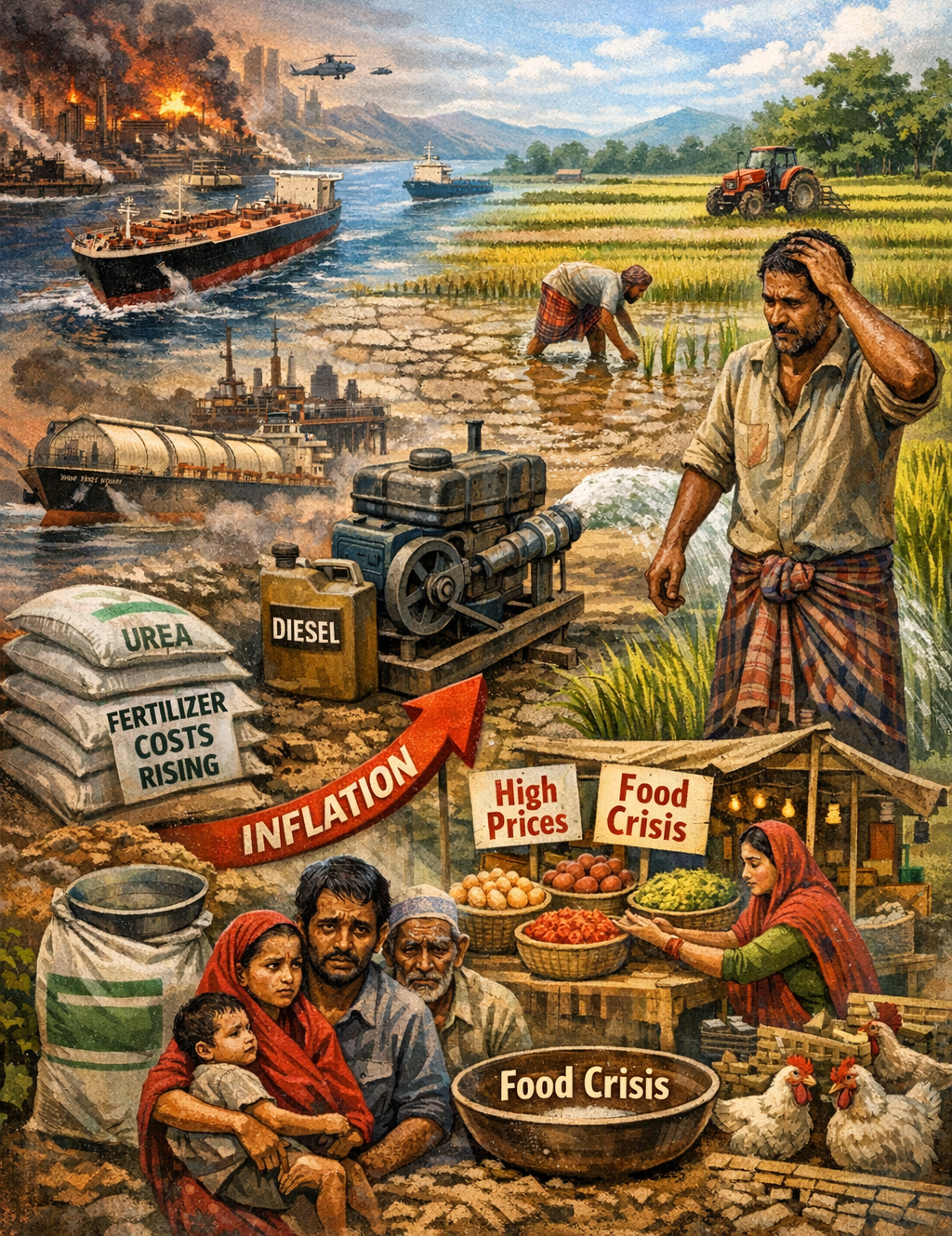
Photo: AI-generated
Irrigation: The Weak Link
The most fragile point in Bangladesh’s food system is not the port or warehouse it is the irrigation pump. Bangladesh operates about 1.6 million irrigation pumps, nearly 80% of them powered by diesel; much of this irrigation supports water-intensive boro cultivation [3]. Dry-season boro rice the backbone of national production depends heavily on irrigation because rainfall is scarce.
Diesel is the most consumed fuel in the country, accounting for around 73% of the country's total fuel consumption [4]. When diesel prices rise sharply, irrigation, transport and farm mechanization service costs increase immediately. Farmers either pay more for water or reduce irrigation hours to manage expenses. For small farmers already operating on thin margins, this is not theoretical. Higher fuel prices mean less irrigation, delayed watering, and lower yields. Many will reduce production because of the rise in cost, which will lead to an increase in imports. The implications for national food supply are serious. Boro rice production has been central to Bangladesh’s progress toward food self-sufficiency [5]. If irrigation becomes unreliable because fuel prices spike or supplies become uncertain, the consequences will be felt in both production and prices.
The government must therefore treat irrigation fuel as a strategic priority during this crisis.
Ensuring uninterrupted diesel supply for agricultural regions during irrigation seasons should become an explicit policy objective. Transparent distribution mechanisms and targeted allocation for agricultural use would prevent supply disruptions from cascading into crop losses.
Fertiliser: The Second Shockwave
Energy volatility is only part of the problem. Fertiliser markets are also tightly linked to global energy and shipping networks. When geopolitical tensions disrupt supply routes or raise freight costs, fertilizer prices can rise dramatically [6]. Bangladesh imports large quantities of fertilizers such as urea, diammonium phosphate, triple superphosphate and muriate of potash. Any disruption in shipping routes through the Gulf or surges in transport costs can push import prices upward, increasing the government’s subsidy burden and farmers’ input costs [7]. The impact does not stop rice cultivation. Fertilizer price shocks affect maize production, which is a key component of poultry and livestock feed. Bangladesh’s rapidly expanding poultry sector depends heavily on maize-based feed [8]. When feed costs rise, the prices of eggs and chicken soon follow, placing additional strain on household budgets.
What begins as a maritime security issue can quickly become a nutrition crisis.
Why the Poor Suffer First
Price shocks do not affect all households equally. Poor families suffer the most because food takes up the largest share of their household budget. Higher diesel prices raise costs throughout the supply chain from irrigation and harvesting to transport and market distribution. If fertilizer prices rise simultaneously, farmers may reduce input use or take on more debt, both of which increase the risk of lower yields [9]. At the consumer level, low-income households have little room to adapt. They cannot stockpile food or switch to premium suppliers. Instead, they reduce food consumption or substitute cheaper, less nutritious options [10].
This is how distant wars quietly translate into hunger at home.
What the Government Must Do Now
The government must act quickly to reduce these risks. Four priorities stand out.
First, protect irrigation continuity. Fuel supply planning must prioritize agricultural irrigation during critical cropping seasons. Strategic fuel reserves and targeted distribution mechanisms can help ensure that farmers have uninterrupted access to diesel.
Second, strengthen fertilizer procurement strategies. Bangladesh should diversify import sources and secure supply contracts early, before geopolitical shocks drive prices even higher. Timely procurement can prevent panic buying during market peaks. Missions abroad should find import market at competitive prices.
Third, expand targeted consumer protection. Market interventions, food assistance programs, and cash transfers can help protect vulnerable households from sudden spikes in food prices without imposing unsustainable fiscal costs.
Fourth, integrate freight and insurance risks into macroeconomic planning. Rising shipping costs are not temporary inconveniences; they directly affect import bills for fuel, food, and agricultural inputs. Economic policy must anticipate these shocks rather than react after prices surge.
Building Resilience for the Future
Emergency measures alone will not protect Bangladesh from future global disruptions. Structural reforms are equally important.
The most important long-term solution is reducing dependence on diesel irrigation. Solar and grid-powered irrigation can reduce farmers’ exposure to volatile fuel markets. This could ring the bell of attaining NDC goal at accelerated way. However, these programs must be designed carefully to avoid groundwater overuse and ensure equitable access for small farmers [11].
Second, improving input efficiency in agriculture can reduce vulnerability to fertilizer price shocks. Conservation, precision agriculture practices and improved nutrient management can lower fertilizer use while maintaining yields [12]. Input use efficiency is lower in Bangladesh; it must be enhanced to reduce loss.
Third, strengthening mechanization services and agricultural extension systems can help farmers maintain productivity even when labor or input costs rise [13].
Fourth, digital early-warning systems and better agricultural advisory services can allow farmers to respond more effectively to changing conditions, reducing crop losses and improving decision-making [14].
Finally, promotion of diversification. Farm households with diversified livelihoods are better positioned to build resilience during crises such as war-induced economic shocks because they are less dependent on a single, vulnerable source of income. When rising fuel and fertilizer prices disrupt agricultural production, households that engage in multiple activities such as livestock rearing, small businesses, wage labor, or remittances can offset losses from farming with alternative earnings. Our dipstick survey among RUPANTAR project beneficiaries revealed that households with diversified activities are less affected compared to those who depended on single crop rice.
References
[1] U.S. Energy Information Administration. (2024). Today in Energy: Amid regional conflict, the Strait of Hormuz remains critical oil chokepoint. https://www.eia.gov/todayinenergy/detail.php?id=65504
[2] Dhaka Tribune. (2026). DCCI concerned about risks to Bangladesh's economy.https://www.dhakatribune.com/business/405249/dcci-concerned-about-risks-to-bangladesh-s-economy
[3] International Water Management Institute (IWMI). (2023). What the evidence says about solar irrigation and groundwater sustainability in Bangladesh.https://www.iwmi.org/blogs/what-the-evidence-says-about-solar-irrigation-and-groundwater-sustainability-in-bangladesh/
[4] Munim, J. M. A., Hakim, M. M., & Abdullah‑Al‑Mamun, M. (2010). Analysis of energy consumption and indicators of energy use in Bangladesh.Economic Change and Restructuring, 43, 275–302. https://link.springer.com/article/10.1007/s10644-010-9091-7
[5] Goletti, F. (1994). The changing public role in a rice economy approaching self‑sufficiency: The case of Bangladesh (Research Report No. 98). IFPRI. https://cgspace.cgiar.org/items/6520d790-cf99-4539-a7e0-1863fc25b193/full
[6] PMC. (2023). [Article from the National Center for Biotechnology Information]. https://pmc.ncbi.nlm.nih.gov/articles/PMC10015268/
[7] AgWeb. (2024). Conflict in Iran ripples through global fertilizer markets, raises prices even higher.https://www.agweb.com/news/conflict-iran-ripples-through-global-fertilizer-markets-raises-prices-even-higher
[8] USDA Foreign Agricultural Service (FAS). (2025). Bangladesh Grain and Feed Update (Report BG2025‑0010).https://apps.fas.usda.gov/newgainapi/api/Report/DownloadReportByFileName?fileName=Grain+and+Feed+Update_Dhaka_Bangladesh_BG2025-0010
[9] Hebebrand, C., & Laborde Debucquet, D. (2022, April 30). High fertilizer prices contribute to rising global food security concerns. Food Security Portal / IFPRI Blog. https://www.ifpri.org/blog/high-fertilizer-prices-contribute-rising-global-food-security-concerns/
[10] PMC. (2023). [Article from the National Center for Biotechnology Information]. https://pmc.ncbi.nlm.nih.gov/articles/PMC10015268/
[11] International Water Management Institute (IWMI). (2023). What the evidence says about solar irrigation and groundwater sustainability in Bangladesh.https://www.iwmi.org/blogs/what-the-evidence-says-about-solar-irrigation-and-groundwater-sustainability-in-bangladesh/
[12] ResearchGate. (2015). Conservation agriculture options for rice–maize cropping systems in Bangladesh.https://www.researchgate.net/publication/276087416_Conservation_agriculture_options_for_a_Rice-Maize_cropping_systems_in_Bangladesh
[13] Cereal Systems Initiative for South Asia (CSISA). (2024). Annual report: Bangladesh mechanization and extension activity (Oct 2023–Sept 2024).https://csisa.org/the-feed-the-future-bangladesh-cereal-systems-initiative-for-south-asia-mechanization-and-extension-activity-annual-report-october-2023-september-2024/
[14] CGIAR Big Data. (2024). Digital warning system boosts resilience in Bangladesh.https://bigdata.cgiar.org/blog-post/digital-warning-system-boosts-resilience-in-bangladesh/
Dr Ravi Nandi, Policy and Food Systems Economist, CGIAR CIMMYT, Bangladesh and Ms. Anupama Islam Nisho, Assistant Research Associate, CIMMYT-Bangladesh
*The views and opinions expressed in this article are solely those of the authors and are presented in a personal capacity.