
Why a Conflict Thousands of Miles Away Could Shake Nepal’s Food System
For Nepal, the effects of a conflict in or around Iran would not appear first as geopolitical headlines. They would surface as rising diesel prices, costlier fertilizers, higher freight charges, and deepening uncertainty in a remittance‑dependent rural economy. Nepal is geographically far from the Gulf but economically exposed. The country imports all its petroleum products, almost entirely through India, making it acutely sensitive to global oil market shocks [1].
The Strait of Hormuz, through which roughly 20 percent of the world’s oil trade moves, is therefore central to Nepal’s economic vulnerability. Nearly 40 percent of India’s crude oil imports transit this chokepoint [2]. Since Nepal’s fuel supply depends on India’s refining and re‑export arrangements, any disruption in the Gulf quickly reaches Nepal through higher Indian import costs and tighter supply chains. For Nepal’s agriculture sector, these shocks would be both rapid and far‑reaching.
Fuel Shock
The first and most immediate impact would come through diesel. Nepal’s agriculture still relies heavily on diesel-powered irrigation and farm machinery. Across the Indo‑Gangetic Plains, including Nepal’s Terai, diesel pumps account for more than 80 percent of irrigation pumps [3]. Diesel also powers tractors, harvesters, threshers, and transplanters, which are increasingly promoted through government programs such as the National Agriculture Modernization Program [4].
But this mechanization drive is highly energy‑sensitive. Mechanization services in Nepal are dominated by private rental markets, where operators pass fuel price changes directly to farmers [5]. For smallholders operating on thin margins, higher diesel prices raise cultivation costs at every production stage from land preparation, irrigation, harvesting to post‑harvest operations. A conflict-driven spike in global oil prices could therefore slow or even reverse Nepal’s progress toward agricultural mechanization.
Agricultural Inputs shock
Fuel is only the first transmission channel. Nepal is also heavily dependent on imported agricultural inputs, especially fertilizers and pesticides. Nepal imports nearly all of its chemical fertilizers through international tenders, with most shipments entering Nepal via Indian ports and logistics networks [6]. More than 90 percent of pesticides used in Nepal are imported as well, mostly routed through Indian markets [7].
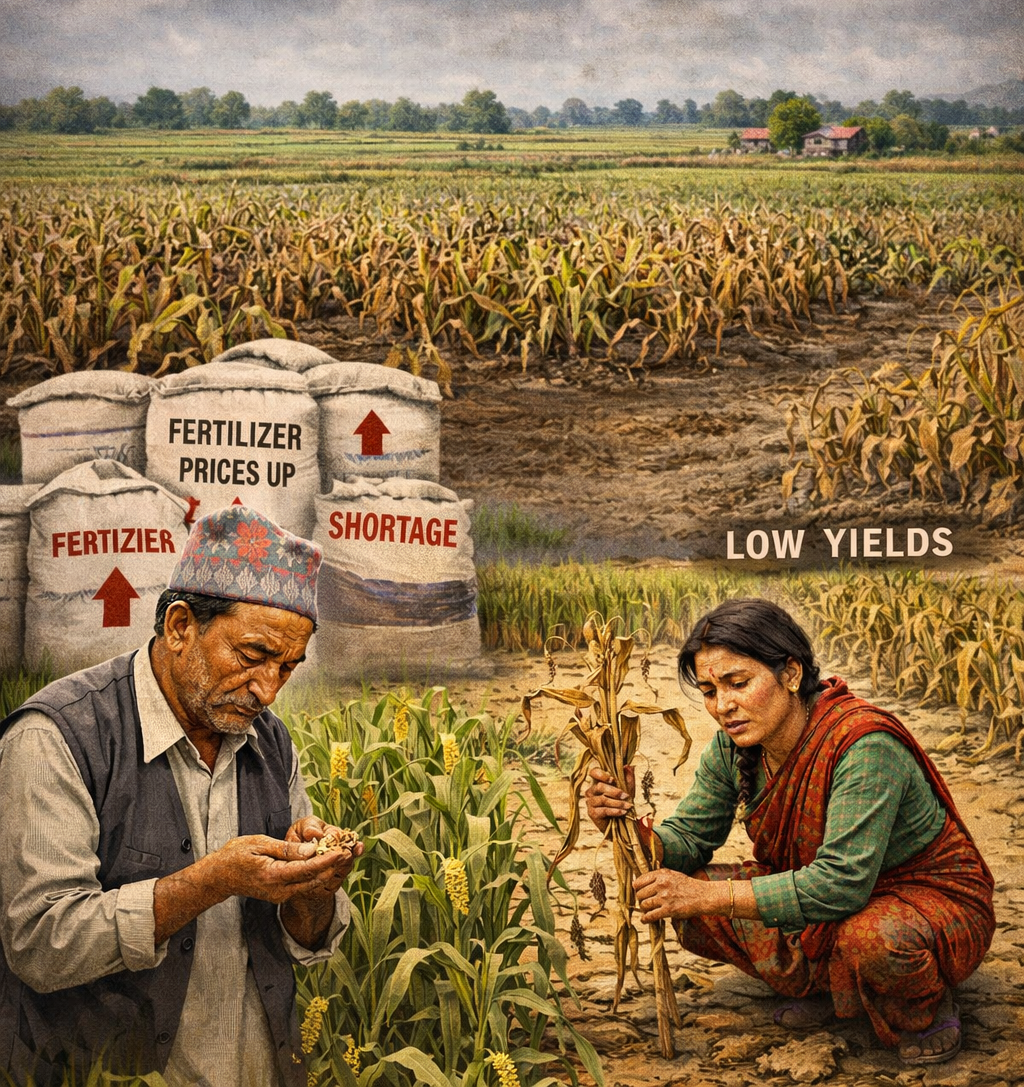
Photo: AI-generated
As a landlocked country, Nepal is highly vulnerable to global shipping disruptions. Rising marine insurance premiums, higher freight rates, and increased fuel surcharges all push up the landed cost of agricultural inputs even before they reach Nepal’s border. Transport within Nepal, across mountainous terrain and weak logistics networks, adds further cost escalation. These increases matter because smallholders in Nepal display highly price‑sensitive input demand. When fertilizer prices rise or supplies become uncertain, farmers frequently reduce application rates, leading to lower yields. Thus, a maritime security crisis in the Persian Gulf can ultimately translate into reduced fertilizer use in Nepal’s rice, wheat, and maize fields.
The Remittance Channel
Nepal’s deeper vulnerability lies in its dependence on migrant labor and remittances. Remittances contribute roughly a quarter of Nepal’s GDP making the country one of the world’s most remittance‑dependent economies [8]. Approximately 41 percent of these remittances originate from Gulf countries, where an estimated 1.9 million Nepalis are employed [9].
If conflict escalates, labor demand in the region could weaken. Construction projects may slow, and migrant workers could face layoffs or forced return. A decline in remittances would have immediate consequences for rural households. Remittance income in Nepal not only supports consumption but also finances agricultural investment like seeds, fertilizers, machinery rentals, irrigation, and land preparation. Moreover, smallholders agricultural productivity have been found to be directly boosted by remittances [10]. At the macro level, remittances are crucial for maintaining foreign exchange reserves needed to import fuel, fertilizers, and farm machinery. So, a drop in remittances during a global supply shock would therefore amplify the pressures on Nepal’s agricultural economy.
Building Agricultural Resilience
Nepal cannot influence geopolitical events in the Middle East, but it can reduce its vulnerability to them. In the short term, ensuring uninterrupted diesel supply during peak irrigation seasons, strengthening fertilizer procurement systems, and monitoring agricultural input availability are essential. Diversifying fertilizer import sources and improving logistical resilience can prevent supply disruptions from escalating into nationwide crop losses.
Over the long term, structural transformation is necessary. Reducing dependence on diesel-based irrigation through solar and electric alternatives can stabilize production costs. Similarly, promoting conservation agriculture, precision nutrient management, and integrated soil fertility practices can raise productivity while lowering fertilizer dependence.
Ultimately, global conflicts may lie beyond Nepal’s control but the fragility of its agriculture need not. Strengthening resilience within Nepal’s farming systems is now not only a development priority but an economic imperative.
References
[1] News18. (2025). Nepal gets its petrol and electricity from India: Then why is it cheaper there?https://www.news18.com/world/nepal-gets-its-petrol-and-electricity-from-india-then-why-is-it-cheaper-there-ws-dkl-9564376.html
[2] U.S. Energy Information Administration. (2026). World oil transit chokepoints. https://www.eia.gov/international/analysis/special-topics/World_Oil_Transit_Chokepoints
[3] Foster, T., Adhikari, R., Urfels, A., Adhikari, S., & Krupnik, T. J. (2019). Costs of diesel pump irrigation systems in the Eastern Indo‑Gangetic Plains: What options exist for efficiency gains? International Food Policy Research Institute (IFPRI). https://cgspace.cgiar.org/server/api/core/bitstreams/3f9719cd-2f2a-4f6b-9da5-b94958416aba/content
[4] Prime Minister Agriculture Modernization Project (PMAMP). (2026). Government of Nepal. https://pmamp.gov.np/
[5] Sharma, K. (2026). Mechanization without ownership: Market structure and pricing in Nepal’s Terai. CABI Agriculture and Bioscience, 7(1). https://www.cabidigitallibrary.org/doi/epdf/10.1079/ab.2026.0020
[6] The Annapurna Express. (2024). https://theannapurnaexpress.com/story/57392/
[7] Khanal, D., Neupane, S. K., Poudel, S., & Shrestha, M. (2021). An overview of chemical pesticide import in Nepal. Journal of Agriculture and Environment, 22, 121–134. https://www.nepjol.info/index.php/AEJ/article/view/46810
[8] World Bank. (2024). Personal remittances, received (% of GDP) – Nepal. https://data.worldbank.org/indicator/BX.TRF.PWKR.DT.GD.ZS?locations=NP
[9] Banjade, Y., & Tamang, S. (2026). Conflict in West Asia jolts regional security, threatens Nepal’s economy. The Kathmandu Post. https://kathmandupost.com/national/2026/03/04/conflict-in-west-asia-jolts-regional-security-threatens-nepal-s-economy
[10] Justice, S., Biggs, S., et al. (2020). Agricultural mechanization and South Asia: Emerging evidence and implications. Journal of Rural Studies, 74, 1–12. https://www.sciencedirect.com/science/article/abs/pii/S2452292920300254
*The views and opinions expressed in this article are solely those of the author and are presented in a personal capacity.
Saurya Karmacharya, CIMMYT-Nepal