
Perspectives of Social Network- The invisible Web of Transformation in Rupantar
“Human beings are connected by invisible bonds; by chains of mutual dependence.” Rabindranath Tagore
Human life is fundamentally built upon relationships. From morning tea-stall conversations to discussions in village markets, from neighbours exchanging farming advice to women sharing livestock experiences in self-help groups, social interaction shapes everyday rural life. A farmer often decides whether to adopt a new crop practice after observing another farmer’s success. An animal rearer may seek guidance from an experienced neighbour before treating a sick animal. Someone facing irrigation problems may consult a respected local farmer who has practical field experience. These interactions may appear ordinary, but together they form a complex web of communication, trust, cooperation, and influence. This invisible web is called a network. A network simply refers to a system of interconnected individuals or entities linked through relationships. In social settings, these relationships may involve friendship, advice-sharing, cooperation, resource exchange, trust, or information flow. Human beings rarely function in isolation; rather, decisions and actions are shaped by continuous interaction with others. In villages particularly, social relationships strongly influence agricultural practices, livelihood choices, technology adoption, and access to institutional support. When these relationship patterns are studied systematically through a scientific approach, it is known as Social Network Analysis (SNA). Social Network Analysis is an approach used to understand how people and institutions are connected and how formal and informal information, influence, and resources move through these connections. In SNA, individuals or organizations are considered “actors” or “nodes,” while the relationships between them are called “ties” or “links.” The approach helps answer practical questions such as: Who are the most influential people in a community? Through whom does information spread most rapidly? Which farmers are highly connected? Who acts as a bridge between farmers and institutions? Which groups remain isolated from mainstream communication systems?
Social Network Analysis has become decidedly important because farming community function largely through interpersonal and institutional relationships. Farmers do not depend only on formal communication channels. They also learn through observation, discussion, and local experiences. Technologies spread not merely through formalized institutional channels but through trust-based social interactions. Therefore, understanding the communication structure of a community becomes essential for designing effective and sustainable interventions. This importance becomes especially relevant in the Rupantar pathway intervention areas across India, Nepal and Bangladesh, where diversified agricultural pathways are being addressed. Each of these intervention areas possesses distinct technical, ecological, and social dynamics. Consequently, the patterns of communication, influence, cooperation, and stakeholder interaction also differ across pathways. Therefore, social network analysis provides a scientific way to understand these differences and identify how knowledge and influence circulate within and beyond the community through both formal and informal channels (Rockenbauch & Sakdapolrak, 2017).
An important aspect of social network analysis is that networks do not involve only farmers or community members. Rural development systems are also connected with multiple institutional stakeholders who shape knowledge dissemination, technical support, and resource access. In the Rupantar intervention areas, several formal actors become part of the wider agricultural communication network, for example Uttar Banga Krishi Viswavidyalaya, the Department of Agriculture, the Department of Animal Husbandry, Krishi Prajukti Sahayaks (KPS), veterinary officers, local extension personnel, NGOs, input suppliers, and market actors in West Bengal. Farmers often depend upon these stakeholders for technical guidance, disease management support, irrigation advice, improved seed recommendations, vaccination services, and access to government schemes. However, the effectiveness of institutional support systems depends largely upon how well these institutions are socially connected with local communities. Across different pathways, the identity of the most trusted source of information may vary considerably. In some situations, an ordinary villager may emerge as the most reliable source, while in others, the local input dealer assumes that role. In another pathway, a veterinary assistant may become the central figure for providing livestock rearing advice. Likewise, scientists from UBKV, AFU or BAU may exert an indirect influence on farming systems by engaging with progressive farmers, who in turn share knowledge among their peers. Social Network Analysis helps uncover these linkages and reveals how formal institutional knowledge becomes embedded within community-level social structures.
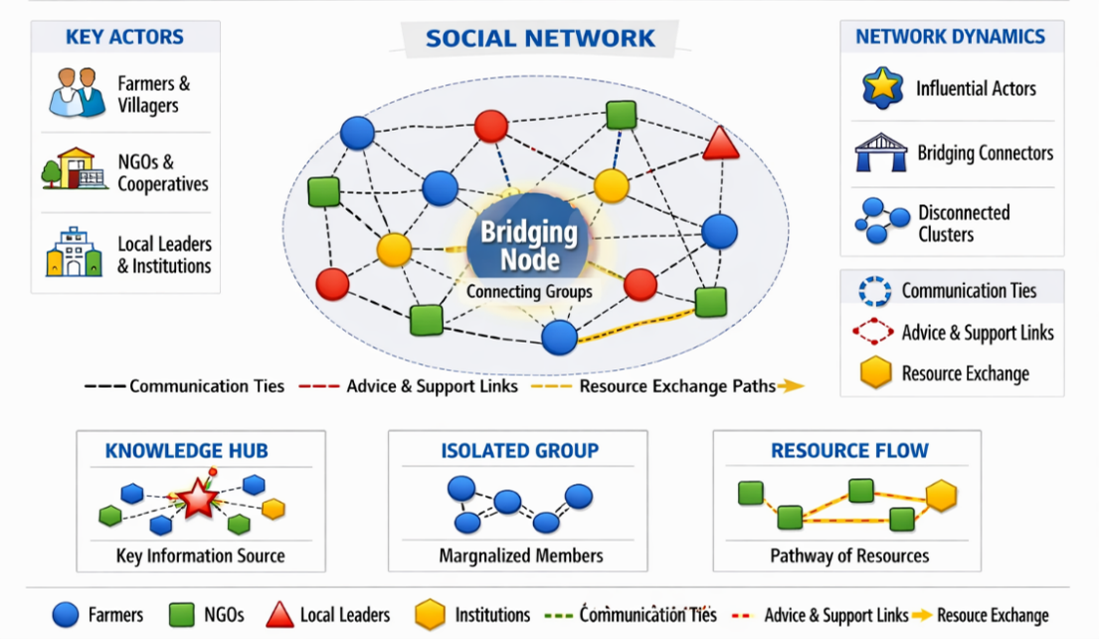
Figure- Conceptual Framework of Social Networks
One of the major strengths of SNA lies in identifying influential and central actors within networks. Some individuals maintain a large number of connections, communicate frequently with others, or hold strong trust relationships within the community. Such actors become highly important because they can rapidly disseminate information across multiple households. If extension agencies strategically involve these socially influential individuals, outreach effectiveness can improve substantially. Instead of relying solely on traditional extension methods, interventions can utilize naturally existing communication pathways within the village. At the same time, SNA also identifies bridging actors who connect different social groups. In rural areas, communities may sometimes be divided based on geography, caste, livelihood type, gender, or economic status. Certain individuals function as bridges between these groups and help transfer information across social boundaries. These bridging actors are extremely important because they help ensure that innovations and institutional support reach wider sections of the community rather than remaining concentrated within limited clusters (Hoang et al., 2006; Hermans et al., 2017).
Another important contribution of Social Network Analysis is understanding the interaction between formal and informal communication systems. Formal communication channels include agricultural officers, scientists, extension personnel, veterinary departments, and training programs. Informal communication channels include neighbours, relatives, progressive farmers, local traders, and community discussions. In practice, farmers often combine information from both systems before making decisions. A farmer may first hear about ZT mustard cultivation from an extension officer but may adopt it only after observing neighbouring farmers’ experiences. Similarly, goat vaccination campaigns often become more successful when trusted local rearers reinforce official messages through peer interaction. SNA helps map these interconnected communication pathways and identify where information gaps or communication bottlenecks exist. Social Network Analysis is also highly valuable for identifying marginalized or socially isolated actors within communities. Not all farmers possess equal social access. Smallholders, remote households, women farmers, or economically weaker groups may sometimes remain disconnected from mainstream communication systems. Such isolation can reduce access to innovations, institutional support, and livelihood opportunities. By identifying these socially isolated nodes, interventions can be redesigned to ensure more inclusive participation and equitable knowledge dissemination (Guerrero-Ocampo & Díaz-Puente, 2023).
The significance of SNA becomes even more important from the perspective of long-term sustainability. Development projects like Rupantar often provide intensive external support during implementation phases, but sustaining impacts after project intervention requires strong local ownership and decentralized knowledge systems. In this context, farmer-to-farmer networks become extremely valuable. When technically capable and socially respected farmers are identified and strengthened through training of trainers and capacity-building approaches, they can continue sharing practical knowledge even after the project phase ends. Such peer-learning systems are often more sustainable, trusted, and cost-effective than externally dependent extension models. In the plot or irrigation-constrained pathways across countries, experienced adopters can guide neighbouring farmers regarding machinery use, sowing practices, residue management, integrated nutrient management, and irrigation practices. In non-plot areas, trained livestock rearers can continue advising others regarding vaccination, disease prevention, feeding management, and breed improvement. Over time, these interactions gradually create self-sustaining community learning systems that continue beyond the project period (Wood et al., 2014).
Eventually, Social Network Analysis recognizes a simple but powerful reality that development spreads through relationships. Technologies alone do not transform communities unless people trust, communicate, cooperate, and learn from one another. In the Rupantar pathway intervention areas of India, Nepal and Bangladesh, understanding these human and institutional connections is essential for strengthening agricultural innovation, livelihood resilience, stakeholder coordination, and sustainable community-based extension systems. By revealing how farmers, institutions, local leaders, and stakeholders interact within everyday rural life, Social Network Analysis provides a valuable framework for building more participatory, inclusive, and sustainable pathways of development.
References
Guerrero-Ocampo, S. B., & Díaz-Puente, J. M. (2023). Social network analysis uses and contributions to innovation initiatives in rural areas: a review. Sustainability, 15(18), 14018.
Hermans, F., Sartas, M., Van Schagen, B., Van Asten, P., & Schut, M. (2017). Social network analysis of multi-stakeholder platforms in agricultural research for development: Opportunities and constraints for innovation and scaling. PloS one, 12(2), e0169634.
Rockenbauch, T., & Sakdapolrak, P. (2017). Social networks and the resilience of rural communities in the Global South: a critical review and conceptual reflections. Ecology and Society, 22(1).
Wood, B. A., Blair, H. T., Gray, D. I., Kemp, P. D., Kenyon, P. R., Morris, S. T., & Sewell, A. M. (2014). Agricultural science in the wild: A social network analysis of farmer knowledge exchange. PloS one, 9(8), e105203.