
Beyond the Seed: Scaling Agricultural Innovation Systems in the Eastern Gangetic Plains
‘It's not the Technology that Scales - It's the System around It’
Across nine villages in India, Nepal, and Bangladesh, the Rupantar project offers a clear lesson for scaling agricultural innovation: technologies do not scale by themselves. They scale when the agricultural innovation system around them makes them usable, timely, inclusive, and economically meaningful for farmers.
In late October, after the aman paddy is harvested, the fields around Unishbisha in Cooch Behar of India enter a short three-week window before the boro season begins. For years, much of this land remained fallow during that period. Today, more and more plots are being planted with mustard. This change did not happen by chance. It happened because the local NGO, Satish Satmile Club of Pathaghar, was active; scientists from Uttar Banga Krishi Vishwavidyalaya (UBKV) were reachable in person and through WhatsApp; the zero-till seeder, seed, herbicide, and fertiliser arrived together within the planting window; and a farmer producer company was in place to support farmers. It also happened because a neighbour had tried it the year before and it had quietly worked.
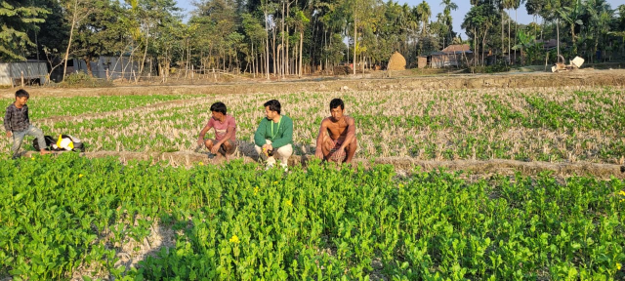
Photo by: Gunjan Rana, CIMMYT-India
That is the wider lesson from the Rupantar fields. When the surrounding support structure works on time and farmers can rely on it, they are more willing to try something new. When that support structure is also inclusive, the chances of a practice lasting and reaching others become much stronger.
What Makes a Practice Scale?
Across the Eastern Gangetic Plains (EGP), the specific practices look very different. In some places, farmers are using zero-till mustard or zero-till maize. In others, they are testing poly-mulched chilli, multilayer arecanut farming, improved mustard, brinjal cultivation, dairy, goats, or native poultry. The agronomy, economics, and social setting differ from one place to the next.
Yet a common pattern runs through them. When farmers describe what helped a practice take root, they rarely begin with the technology itself. They speak first about someone local they trusted, then about whether inputs and advice arrived on time, and finally about whether there was a market, a buyer or some clear economic return at the end.
This is why the idea of an agricultural innovation system matters so much for scaling. Adoption does not depend on technology alone. It depends on the relationships, services, institutions, and market links that make a technology usable in a real farming season. This is also where the Scaling for Impact (S4I) program’s emphasis on scaling science becomes important: Rupantar shows that scaling is not only about expanding reach, but also about understanding the conditions, incentives, and institutional arrangements that allow an innovation to travel across places and social groups. Through the CGIAR S4I program, the CIMMYT’s Rupantar team has piloted the use of concrete scaling tools such as the Scaling Scan. This pilot has helped us translate the abstract idea of ‘scaling an innovation system’ into an internal process of diagnosing bottlenecks across our diversification pathways. Building on this experience, we plan to use the Scaling Scan in future pathway reviews with farmers and other partners, so that decisions about where and how to scale are grounded in a shared understanding of system constraints.
This pattern is visible beyond Unishbisha. In Morang (Nepal), zero-till maize is moving from one farmer to another not only because a machine exists, but because custom hiring, local coordination, technical support, and neighbour-to-neighbour learning are all in place. In Jhapa (Nepal), multilayer arecanut farming is gaining ground because training, planning, and institutional support are helping farmers manage their orchards differently. The lesson is straightforward. Scaling does not happen when a practice is simply promoted. It happens when the surrounding enabling environment reduces the frictions that normally stop adoption.
Inclusion Must Be Part of the System
The same is true for inclusion. It works best when it is built into design from the beginning, rather than counted only at the end.
In Sunsari (Nepal), the dairy pathway grew out of a simple reality. Male migration had left many women managing crops, livestock, household work and childcare at the same time. In that setting, improving dairy was not only about milk yields; it was also about reducing the daily burden on women. When feed and shed management improved, one of the first benefits women pointed to was that they no longer had to spend time cooking porridge for cattle.
In Patlakhawa (India), scientific goat rearing is reaching households where women already do most of the feeding, grass cutting, and sale of young goats. In Lalmonirhat (Bangladesh), improved native chicken rearing is being shaped around the actual rhythm of women’s days, including cooking, childcare, and prayer time. In Gaddarpar (India), the labour-saving effect of poly-mulch matters in part because weeding had fallen heavily on women. These are not side issues. They are design questions that decide whether a pathway fits into people’s lives well enough to continue.
When inclusion is built in this way, it strengthens scaling. Practices are more likely to travel when they work for the people who are actually expected to carry them.
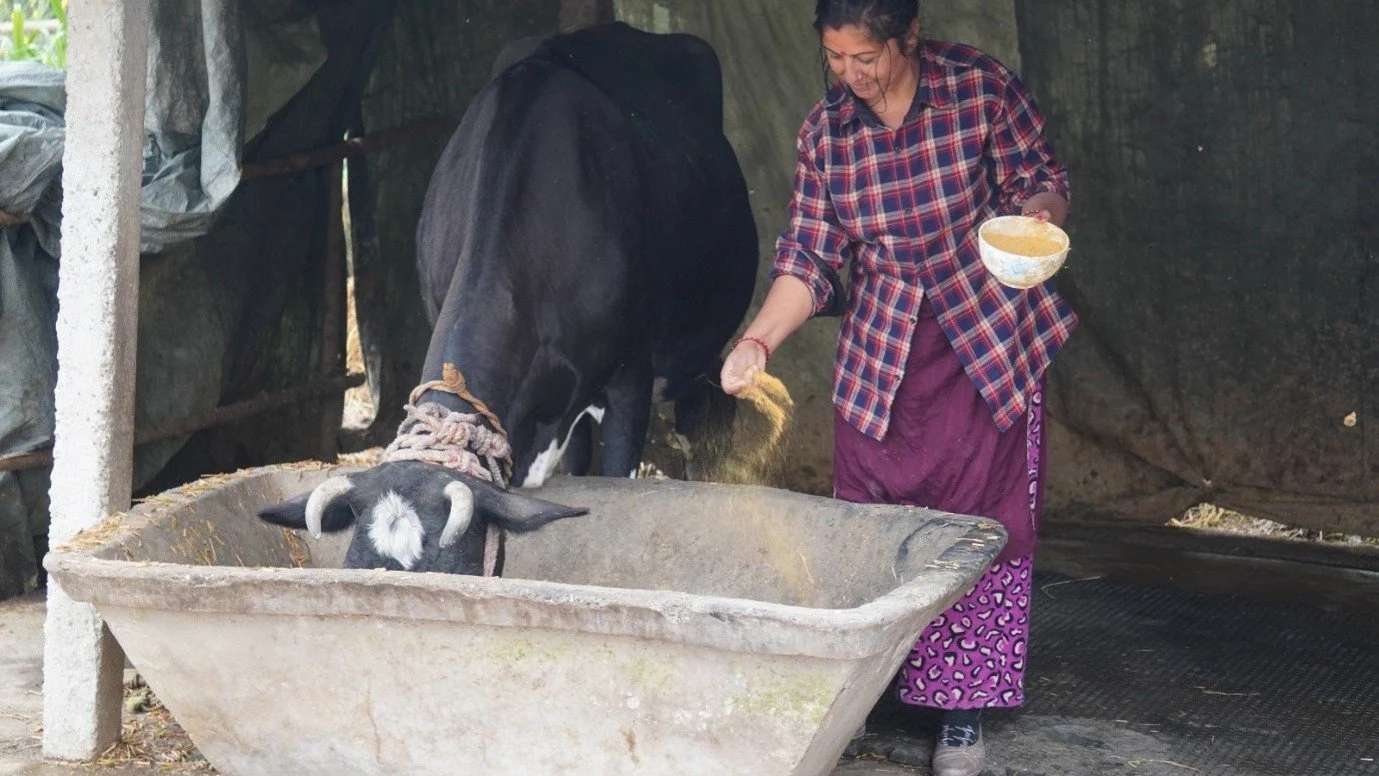
Photo by: Saurya Karmacharya, CIMMYT-Nepal
What Adaptive Scaling Teaches Us
Not every pathway works smoothly in every season. Some of the most useful scaling lessons come from the points where promising pathways do not yet work well enough. These constraints are not failures; they are signals about what the innovation system still needs to provide.
Poly-mulch can make sense agronomically, yet remain out of reach where credit or input supply systems are weak. Zero-till seeder may be available locally but miss the season if calibration and operator support are not in place. Recommended varieties may not spread if farmers cannot access them reliably. Dairy pathways look promising on paper, but farmer confidence drops quickly when cooperative payments are irregular. Even technically sound advisory systems can miss farmers if the way information is delivered does not match how farmers actually seek it.
These are not minor operational details. They often decide whether a pathway remains a pilot or begins to scale. They also remind us that scaling requires patience with the practical constraints farmers face every season.
Three Lessons for Scaling Agricultural Innovation
First, scale the innovation system, not the practice alone. Technologies move when the people, services, institutions, and market connections around them move too.
Second, build inclusion into the architecture from the start. When women’s time, mobility, and decision-making are treated as design inputs, the resulting pathway is more likely to be workable in practice.
Third, invest in the enabling environment. Input logistics, machinery services, cooperative governance, advisory feedback loops, and credit instruments often decide whether a practice moves or stalls.
Our engagement with the CGIAR S4I program has taught us that scaling science is most useful when it is built into everyday monitoring and decision-making, rather than added as a separate study. The pilot with the RUPANTAR’s CIMMYT team confirmed that using tools like the Scaling Scan inside our regular reflection processes can help us see system bottlenecks earlier and adapt our scaling choices more deliberately over time.
Farming in the EGP has always meant working within real constraints of water, weather, labour, markets, and social norms. The Rupantar experience suggests that diversification becomes more durable when the surrounding support system is built deliberately and inclusively. For scaling programs, the implication is clear: invest not only in technologies, but also in the relationships, services, institutions, and feedback mechanisms that allow those technologies to stay, spread, and benefit the people they are meant to serve.
Author notes: This reflection draws on field experience from the Rupantar project across sites in India, Nepal, and Bangladesh. The CGIAR Scaling for Impact (S4I) program supports this work through scaling science and learning. Rupantar is funded by ACIAR and implemented with regional research and development partners to advance inclusive diversification pathways in the Eastern Gangetic Plains.
Authors
Bhuvana Narayanarao, Consultant, CGIAR- CIMMYT. She can be reached at bhuvanaditya7@gmail.com
Ravi Nandi, Agricultural Economist and Innovation System Scientist, CIMMYT-Bangladesh. He can be reached at r.nandi@cgiar.org