
The Nexus of Mechanization and Out-Migration: A Potential Case to Be Made in Morang
Farm mechanization is gathering pace in the eastern terai districts of Nepal. The region has seen a surge in the number of both service providers (particularly custom hiring centers) and the types and numbers of farm machinery (more notably specialized machinery like combined harvesters and paddy transplanters) in recent years[i]. On the face of it, it signals an influx of agricultural modernization in the region. Likewise, the behavioral aspect of the users cannot be discarded. Farmers are adopting newer technology more quickly and easily than before[ii]. Tangible benefits have materialized from this ongoing transformation as well. Farmers are getting their tasks done at a much lower cost as opposed to hiring manual labor[iii]. And if a comparison is to be made from the perspective of production economics, mechanized farming would surpass manual farming significantly in terms of productivity per unit cost with the perpetual rise in labor wages.

Photo 1: Chotu Sada, a maize farmer from Mayagunj village in Morang, inspects his zero-tilled maize field after sowing with the seed-cum-fertilizer drill (PC: Samer Khan)
In the context of Rupantar[i], Zero tillage seed cum fertilizer drill was promoted for winter maize cultivation in two rural villages in Morang district of Koshi Province. Within the first year of implementation, farmers noticed many advantages of this non-till practice. Users have experienced efficiency from this technology. Chotu Sadar, an elderly user of the machinery, noted how cost-effective this new technology has been. “The cost of production was low due to the engagement of fewer laborers during land preparation and plantation, and the cost of irrigation was low due to a shorter time period required for irrigation.”, he said. He also added that weed management was easier in the zero tilled fields due to comparatively less weed growth.
Not only did the farmers but experts in the sector view this technology with a positive outlook. Asso. Prof. Suman Dhakal, agronomy expert and the current Director of the Directorate of Farm at AFU (Agriculture and Forestry University, Rampur, Chitwan), was impressed to observe how deep and well-anchored the root system of the standing maize crop sown with zero tillage turned out to be compared to plants from tilled soil. He also noted about how other synergies from this conservation agriculture technology like increased organic matter and carbon content, sustainable soil fertility, and other ecological benefits can be realized in the coming years.
Apart from these technical benefits, and more in line with the essence of this piece, farmers experienced reduced workload and drudgery with the use of the Zero tillage seed drill. Birendra Mandal, another farmer in the project, remarked, “We would have to plant all the maize manually if this machinery (ZT seed drill) did not come to us. Planting maize takes a lot of time…more than you can imagine. This new machinery saves a lot of time for us, which can be spent elsewhere.” They also commonly referred to how farm workload was saved specifically for women who were involved in planting and weeding more than men.
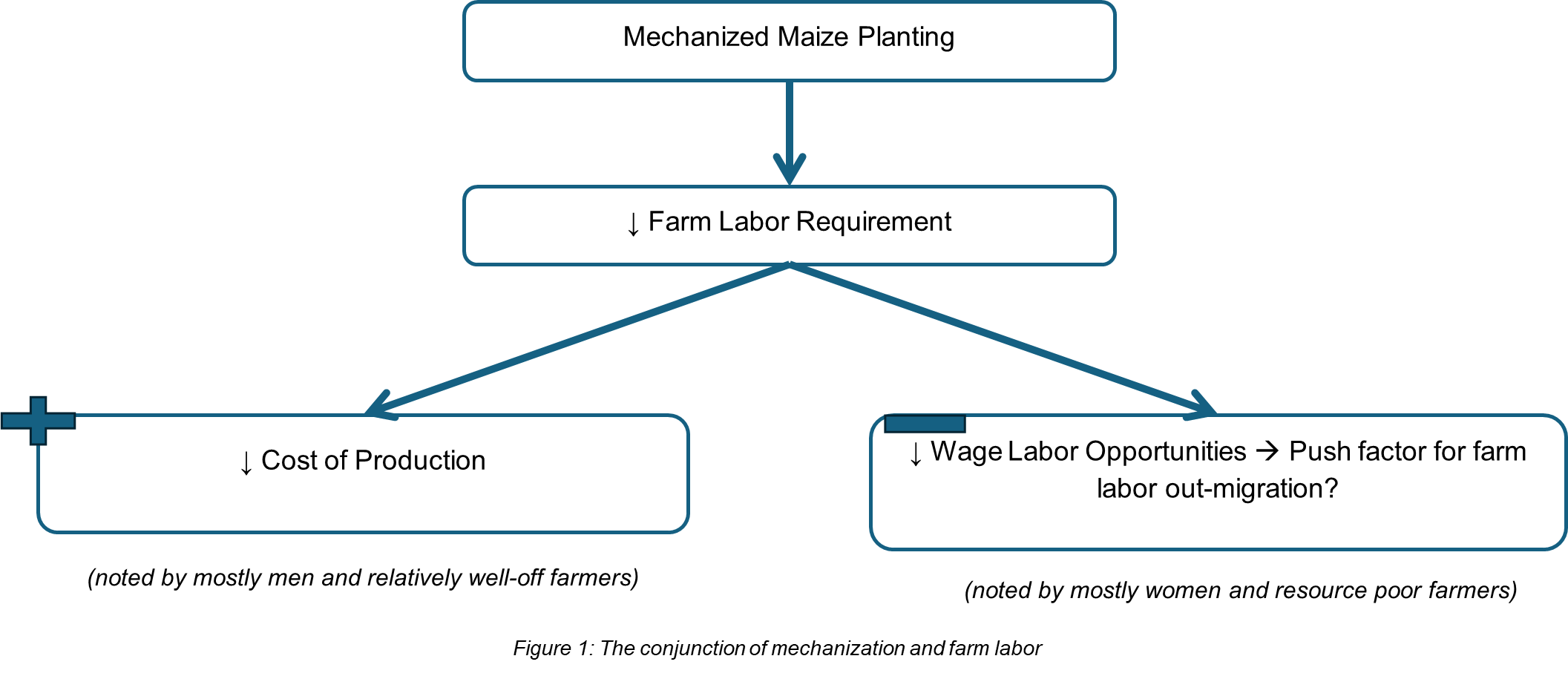
Nevertheless, when some farmers who also worked as hired farm labor were asked about how they found this new technology, their answers were mixed. Lila Devi Mandal, a female farmer, said, “While this new machinery does a good job, it replaces the use of hired labor. If such mechanization continues to come to the village, we will have to find other ways to earn money other than from our farm labor. People say there is a shortage of farm labor in the village. If this kind of machinery comes, there won’t be a need for any farm labor at all.” More importantly, these kinds of statements were mostly made by women (majority of hired farm labor) and resource poor farmers. These references from the ultimate beneficiaries alone create a need to explore the endogeneity of farm mechanization and out-migration.
The Hypothesis
Now, to contextualize, incremental farm mechanization has been the highlight of the last decade for not only these regions but for the entire Nepalese agriculture as a whole. Tractor adoption has almost doubled in the last ten years to over 1.6 million. Similarly, there are now about half a million farmers using power tillers. The use of traditional iron ploughs, on the other hand, has drastically decreased, going from over 850,000 to roughly 510,000 in the same time frame. These figures from the Agricultural Census 2021–2022 clearly indicate a distinct shift from manual to mechanized farming methods[i].
But if one were to raise a question about how this surge in mechanization occurred in the first place, the answer cannot leave out the fact about a looming trend in the country’s demography: a large number of youths are migrating away from farms to cities and abroad. In scientific literature as well, many conclusions have been drawn about how out-migration has led to a rural-transition towards farm mechanization[ii]. This wave of farm labor out-migration might be a result of unprofitable returns from agriculture and minimal farm wages. It can also largely be attributed to the pull of better paying jobs available elsewhere and a kind of demonstration effect from observing an increasing number of migrant neighbors seemingly lead a more “prosperous” life in the community. Amidst all these drivers, critically, the endogeneity of mechanization itself cannot be ruled out, i.e., farm mechanization itself can potentially drive out the farm labor force to at least some extent (a hypothesis).
It is a well-established notion that modernization with technology drives away the need for menial tasks and manual labor. This creates a structural transformation in the domain of employment. History tells us how industrialization changed the panorama of structural unemployment in the past centuries (or decades in the current underdeveloped world). The evolution and democratization of Artificial Intelligence is already showing signs of another structural change. So, there remains a valid base to assess the conjunction of farm mechanization and out-migration from a similar standpoint as well. In this context, there remains a big scope to explore the simultaneous relationship of farm mechanization and rural out-migration, and even more so, from a more nuanced and grounded lens inclusive of both gender and class in these regions. Zero tillage maize in Morang just might provide a textbook case to study this multi-faceted phenomenon.
References:
[i] National Statistics Office (NSO), Government of Nepal. (2023). National Sample Census of Agriculture 2021/22 (National Report). Kathmandu: Government of Nepal.
[ii] Brown, B., Paudel, G. P., & Krupnik, T. J. (2021). “Visualising adoption processes through a stepwise framework: A case study of mechanisation on the Nepal Terai.” Agricultural Systems, 192, 103200. https://doi.org/10.1016/j.agsy.2021.103200
[i] an ACIAR-funded project focusing on understanding practices and processes for diversification of smallholders livelihood in the Eastern Gangetic Plains. Follow to learn more: www.rupantarfoodsystems.com
[i]https://kathmandupost.com/money/2025/10/25/mechanisation-transforms-farming-in-eastern-tarai
[ii] Shrestha, S. (2022). An overview of agricultural mechanization in Nepal. Kathmandu University Journal of Science, Engineering and Technology, 16(2). https://doi.org/10.70530/kuset.v16i2.114
[iii] Takeshima, H. (2017). Overview of the evolution of agricultural mechanization in Nepal: A focus on tractors and combine harvesters. IFPRI Discussion Paper 1662, International Food Policy Research Institute.