
Scaling Smart: Why Agricultural Innovations Must Navigate Trade-Offs and Synergies
Agricultural innovations rarely move in a straight line from research stations to farmers’ fields. A technology may perform well in trials, but farmers adopt, adapt, reject, or modify it based on labour availability, cost, risk, markets, gender roles, input access, and local knowledge. Therefore, judging an innovation only by yield or production gains gives an incomplete picture. Scaling requires systems thinking from the design stage itself one that identifies both the synergies an innovation can generate and the trade-offs it may impose across the operational environment.
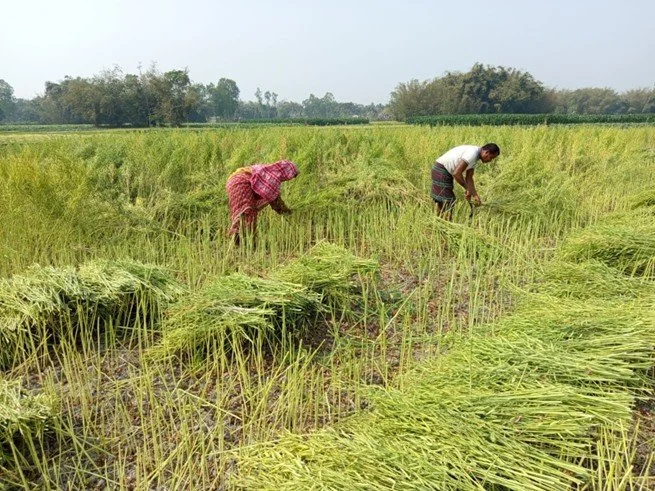
Photo 1: Farmers harvesting mustard (photo by Anupama Islam Nisho, CIMMYT-Bangladesh)
Defining the Multidimensional Impact
A systems approach recognizes that any intervention in an agrifood system will generate effects across multiple interconnected domains. These effects could be direct or spill over, intended or unintended and typically include economic viability, environmental sustainability, labor dynamics, gender equity, social cohesion, household nutrition etc. Within this framework, synergies are the positive co-benefits that occur when an agricultural intervention improves outcomes in more than one domain simultaneously. Trade-offs represent the compromises where a benefit achieved in one specific parameter results in an unintended cost in another.
A classic example is the adoption of long-duration Basmati rice varieties in Punjab and Haryana. Farmers adopted these varieties because the economics were favourable. However, the longer crop duration compressed the window between rice harvest and wheat sowing. The Punjab Preservation of Subsoil Water Act further delayed rice transplanting to conserve groundwater. When mechanized harvesting became common, it left taller stubbles in the field. Together, the short turnaround time, labour shortages, and longer stubbles contributed to the widespread practice of residue burning.
Embedding Trade-Off analysis into Innovation Design
Recognizing these multidimensional interactions at every stage of the technology development cycle is important and that requires a shift in the analytical focus of agricultural research. Instead of simply asking whether a technology functions in a controlled experimental environment, we must understand exactly how it functions within the reality of farmers' context. And in this line, the identification and management of these trade-offs and synergies must be a foundational element of project design, frontline demonstrations, and scaling. Historically, agricultural development programs have treated negative externalities as unforeseen, unintended and uncompensated consequences and managed it reactively. A robust systems approach demands rigorous assessments to map potential trade-offs right from the start.
Building this assessment into the initial design phase requires interdisciplinary methodologies. Agronomic data must be combined with socioeconomic surveys, time use analyses, and environmental impact models. By establishing detailed baseline conditions, researchers can accurately predict how a specific innovation will alter the existing equilibrium.
Scaling as a Continuous Process
The recognition that technological change is not a spontaneous but incremental process changes how we scale agricultural innovations. Scaling cannot be treated as the simple replication of a fixed technology across broader geographic areas. Instead, it must be managed as a continuous, iterative process of localized farmer adaptation and institutional realignment. When a technology is introduced to a new agroecological zone, farmers subject it to rigorous practical testing. They modify agronomic practices, alter physical input ratios, and integrate the new technology with their established traditional knowledge systems. Measuring adoption in simple yes/no metrics, and focusing on singular outcomes as yield or income is problematic. Furthermore, successful scaling depends heavily on concurrent macro level institutional changes, including functional extension services, accessible rural credit markets, and reliable input supply chains and farmer’s evaluation of benefits in transitioning (and farmers might use different metrics for evaluation).
Consequently, all scaling initiatives must incorporate continuous diagnostic monitoring mechanisms. These frameworks are required to detect frictions as the technology interacts with new ecological variables and social structures. If ongoing monitoring indicates that the localized trade-offs of an innovation outweigh its benefits within a specific context, the scaling process must be objective and responsive. In such instances, the appropriate scientific response is not to force adoption through subsidies, but to immediately halt the scaling protocol for that specific region and redesign the intervention to match the context. These principles are not only theoretical but can also be practical as witnessed from the field experiences of the Rupantar project in the Eastern Gangetic Plains (EGP).

Photo 2: Multistakeholder meeting of irrigation constraint pathway at Cooch Behar, India (photo by Gunjan Rana, CIMMYT-India)
Evidence from the Rupantar Project
The relevance of this systems approach is illustrated by field experiences from the Rupantar project, which examined how diversification pathways can generate both trade-offs and synergies depending on the ecological, economic, and social contexts among smallholders in the EGP region of India, Nepal, and Bangladesh. The project evaluated three distinct diversification pathways: plot-based systems like zero tillage in mustard and maize, non-plot-based systems like improved livestock rearing, and irrigation constrained systems like mulching in vegetable crops and multilayer orchards. The interventions were selected following a scientific approach for participatory program development with the help of Scaling Assessment and Discussion (SCAD) tool. The program also had detailed monitoring and evaluation framework specifically designed to examine trade-offs and synergies. The findings demonstrate that every implemented pathway generated complex interactions across the evaluated livelihood dimensions.
For instance, the plot based zero tillage interventions yielded significant documented synergies. These specific practices improved soil moisture retention, conserved crop residues, and provided substantial labor savings. However, these agronomic benefits were counterbalanced by distinct trade-offs, most notably an increased reliance on chemical herbicides for weed control and a measured reduction in economic opportunities for local manual agricultural labor.
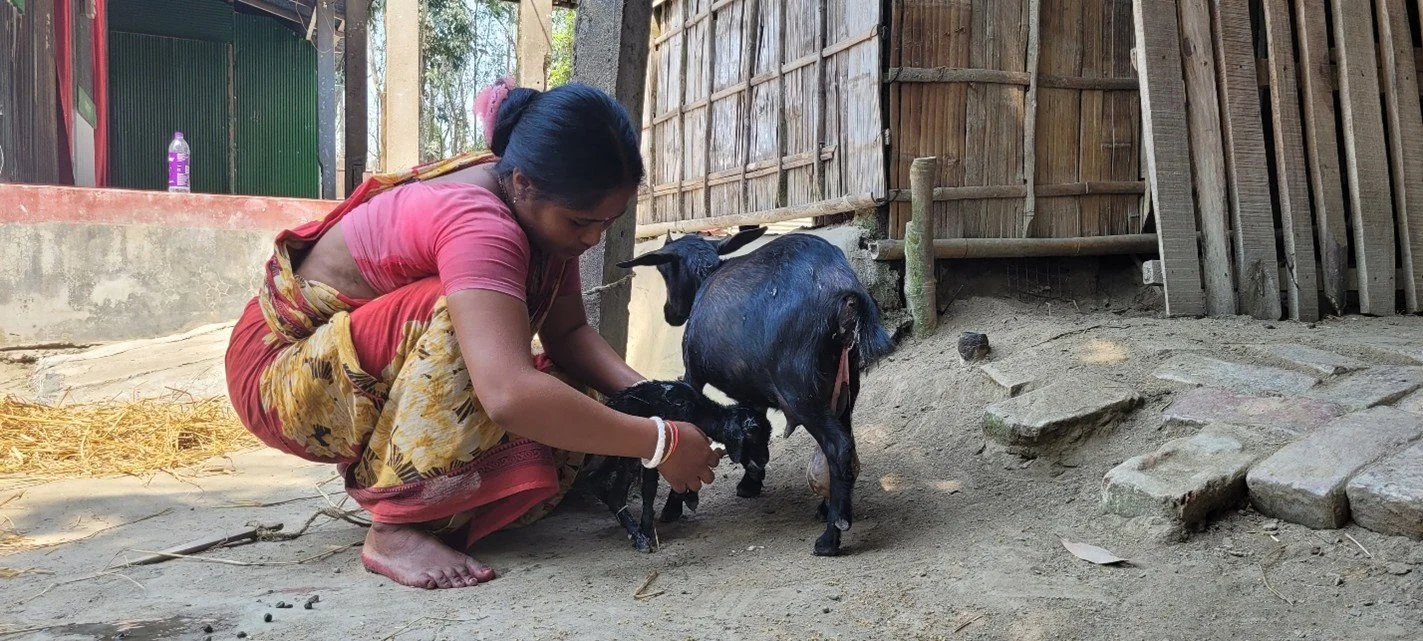
Photo 3: Nurturing newborn ‘Kid’ by a woman goatherd at Cooch Behar, India, (photo by Gunjan Rana, CIMMYT-India)
Similarly, the non-plot livestock diversification pathways successfully created reliable income streams and improved household nutritional security through the increased consumption of dairy and poultry products. Yet, continuous field monitoring revealed a critical gendered trade-off. The adoption of commercial dairy and scientific poultry rearing disproportionately increased the daily workload and uncompensated labor burden on women. Furthermore, these livestock pathways required high upfront capital investments that effectively excluded resource-poor households from participation.
The central lesson is clear: scaling is not only about expanding the reach of an innovation; it is about ensuring that the innovation remains useful, equitable, and sustainable as it moves across contexts. Trade-offs are not reasons to avoid innovation, but they must be identified, monitored, and managed. Similarly, synergies should be deliberately strengthened through appropriate bundles, institutional support, and locally responsive adaptation. Agricultural innovation will scale more responsibly when researchers, development agencies, and policymakers move beyond adoption numbers and ask a deeper question: who benefits, who bears the cost, and under what conditions does the innovation truly transform farming systems?
Acknowledgement: This work was supported by the Australian Center for International Agricultural Research (ACIAR) through Grant No. WAC/2020/148(2021) and by the CGIAR Scaling for Impact (S4I) program. We sincerely acknowledge the support of all funding and field partners that contributed to this research.
Authors
Bhuvana Narayanarao is an independent consultant working for the International Maize and Wheat Improvement Centre (CIMMYT), under Rupantar project. She can be reached at bhuvanaditya7@gmail.com
Ravi Nandi is an Agricultural Economist and Innovation System Scientist at the International Maize and Wheat Improvement Centre (CIMMYT), Bangladesh. He can be reached at r.nandi@cgiar.org