
From Flood to Food Crisis: Building Resilient Mountain Food Systems Amid Extreme Climate Risks
On 26 August 2026 a massive ice rock avalanche in Nepal’s Langtang range crashed into a glacial valley, resulting in a catastrophic flood of water and debris down the Bhote Koshi/Trishuli river corridor. Entire villages were swept away; more than a thousand lives lost and thousands are missing.
What we see now is the tragic loss of life and extensive damage to infrastructure, but the impact of the flood goes beyond this immediate loss. It will have long-lasting impacts on the livelihoods of thousands of smallholder families. The far greater challenge lies ahead as the food system got badly hit in the affected area. The disaster swept away food stocks, destroyed irrigation canals, croplands, livestock and markets in Rasuwa, Nuwakot, Dhading and downstream. According to a preliminary report by the National Disaster Risk Reduction and Management Authority, over 1,806 hectares of agricultural land is destroyed and the food production is expected to go down by 7686 tonnes [1]. Around 2,52,000 livestocks were affected contributing to the substantial economic loss of more than 1 billion Nepali rupees [8].
Like a majority of Nepali households, many affected families along the Bhote Koshi and Trishuli river corridors relied on subsistence farming and livestock rearing as one of the major sources of income outside the hydropower and tourism sectors. So the loss of the agricultural land, livestock and irrigation infrastructures represent more serious damage. The farming families have lost their farm assets along with the destroyed homes affecting the household livelihoods and compounding the economic shock.
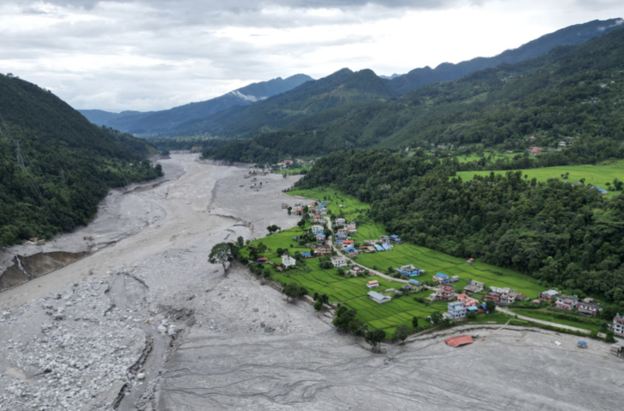
Photo: Hemanta Shrestha/ Kantipur
How Flood Disrupt Farming and Food Systems
Extreme climate disaster such as flash floods carries effects on the local farming communities and the food system in several ways:
Loss of Farmland: High-energy floodwaters washed away fertile topsoil from the cultivable land. And the productive fields got covered with debris and rocks turning it into barren riverbeds and making it unsuitable for agriculture.
Crop and Orchard Destruction: Standing crops got washed away along seasonal harvests. Fruit orchards got submerged or flattened in minutes resulting in immediate and long-term production losses.
Loss of Livestocks: Livestocks got swept away in the floodwater which are not only the important food sources but also the productive assets for the farming families.
Loss of Agricultural Infrastructures: Irrigation canals and tubewells got affected. Many hillside villages depend on small earthen channels to divert stream water. The debris flow destroyed the system leaving the remaining productive fields without water.
Loss of Market Connectivity: Even in the areas where farmlands are not directly hit by the flood, communities still face indirect impacts when roads and bridges are swept away. This cut villages off from markets, agricultural inputs and essential services.
The Wider Implications
The implication of the flood goes far beyond the visible effect on crops and livestocks. It results in
Food Insecurity and Heightened Import Dependency: When the domestic production is compromised in the key pockets, local food shortages may get triggered. So the region faces high risk of increased food imports to stabilize the local supply chains.
Disrupted Livelihoods: Smallholder farmers who lost not only standing and stored crops but also productive farmland face a long recovery period. For the agricultural household these losses can threaten income stability and sustainability and may even force some families to abandon their traditional livelihoods.
Macroeconomic Pressures: Supply bottlenecks, diminished harvests and disruption to transportation and supply chain may result in broader consumer price inflation during critical market seasons.
Building Resilience:
As global warming continues, extreme climate events such as flash floods and landslides as well as droughts, are predicted to become more frequent and severe. In Nepal, agriculture is one of the most vulnerable sectors to the climate induced disaster, as more than 70% of Nepal’s agricultural land is rainfed. It means droughts and floods could have serious implications for food security [5]. So preparing early for the future challenges is essential. Building long-term agricultural resilience along vulnerable mountain corridors requires proactive, systems-level strategies that combine risk reduction, climate adaptation and early recovery activities.
Early Warning and Risk Monitoring:
Technologies such as satellite-based monitoring, automated sensors and locally accessible early-warning systems can help ensure that warnings reach farmers and other vulnerable groups before hazards occur so that they get time to protect themselves, livestocks, crops and other assets.
Resilient Infrastructure:
As physical infrastructure adaptations, technologies such as flood barriers, improved drainage systems, heat-resistant building materials, upgraded transportation networks can be designed and utilized to withstand extreme weather. These hard-engineering solutions provide direct protection against climate impacts.
Nature-based/ Ecosystem based solutions:
Bio-Shields and Watershed Restoration - Restoring alpine vegetation, afforesting fragile mountain slopes, protecting riverbank buffer zones, and preserving mangrove or wetland belts can regulate water flows and reduce flood and erosion risks [6].
Managed Glacier and Lake Engineering - In areas vulnerable to Glacial Lake Outburst Flood (GLOFs), appropriate engineering measures to manage dangerous glacial lakes can complement these ecosystem-based approaches. Interventions like siphon systems, artificial drainage channels, and controlled trenching to safely lower dangerous glacial lake water levels can protect downstream agricultural land and infrastructure [7].
Information and Communication Technologies:
ICT enables better climate preparedness through early warning systems, climate monitoring networks, decision-support tools, and mobile apps that help communities respond to climate threats. Access to information about agricultural technologies such as drought-resistant crop varieties, precision irrigation systems, climate-smart farming practices can be helpful to tackle the issue at farmers level [4].
Climate Resilient Agriculture:
While conservation agriculture such as Zero tillage practice permanent organic soil cover, and crop diversification are widely researched across South Asia to improve soil carbon sequestration and mitigate greenhouse gas emissions, adaptive technology such as transitioning toward flood-tolerant crop varieties as well as locally adaptive crop varieties can help farmers cope with the increasing uncertainty.
Community-Led Adaptation:
Resilience ultimately depends on the capacity of communities to prepare, respond and recover. Empowering local farmer groups and agricultural cooperatives with climate risk literacy and rapid-response recovery funds ensures that rural smallholders can recover more quickly and adapt their farming calendars to shifting seasonal unpredictability.
Diversification:
Diversifying crops, livestock and income sources can reduce households’ dependence on a single livelihood and provide greater flexibility when one part of the farming system is affected by a disaster.
Building resilient mountain food systems therefore requires action across the landscape from glaciers and watersheds to farms, markets and communities. By combining risk monitoring, resilient infrastructure, ecosystem management and locally relevant agricultural practices, Nepal can better prepare its food systems for an increasingly uncertain climate.
References:
[1] Kathmandu Post. (2026, September 7). Floods wash away 1,806 hectares of farmland, threaten food supplies. https://kathmandupost.com/national/2026/09/07/floods-wash-away-1-806-hectares-of-farmland-threaten-food-supplies
[2] Nepal News. (2026, September 8). Bhote Koshi flood: How big is the damage? A sector-by-sector reckoning. https://english.nepalnews.com/s/explainers/bhote-koshi-flood-how-big-is-the-damage-a-sector-by-sector-reckoning/
[3] The Annapurna Express. (2026, September 7). Bhotekoshi-Trishuli flood disaster: A new chapter for Nepal. https://theannapurnaexpress.com/story/66919/
[4] World Association for Industrial and Technological Research Organizations (WAITRO). (15 May 2026). What are climate adaptation technologies? WAITRO
[5] WeAdapt. (4th Oct 2022). Climate resilience planning in mountainous regions in Nepal. WeAdapt
[6] Sudmeier-Rieux, K., Arce-Mojica, T., Boehmer, H. J., Doswald, N., Emerton, L., Friess, D. A., Galvin, S., Hagenlocher, M., James, H., Laban, P., Lacambra, C., Lange, W., McAdoo, B. G., Moos, C., Mysiak, J., Narvaez, L., Nehren, U., Peduzzi, P., Renaud, F. G., Sandholz, S., Schreyers, L., Sebesvari, Z., Tom, T., Triyanti, A., & van Eijk, P. (2021). Scientific evidence for ecosystem-based disaster risk reduction. Nature Sustainability, 4(9), 803–810. https://doi.org/10.1038/s41893-021-00732-4
[7] Wangchuk, T., & Tsubaki, R. (2024). A glacial lake outburst flood risk assessment for the Phochhu river basin, Bhutan. Natural Hazards and Earth System Sciences, 24(8), 2523–2540. https://doi.org/10.5194/nhess-24-2523-2024
[8] भोटेकोशी बाढीबाट कृषि क्षेत्रमा एक अर्बभन्दा बढीको क्षति. (2026, September 14). Kantipur. Kantipur article